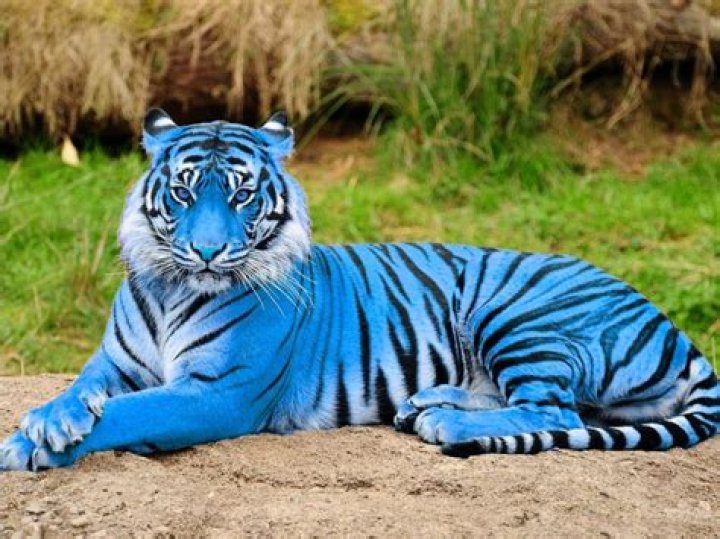
Here are the real genetics of a (probably) fake animal. The blue tiger, or maltese tiger, came to international attention in 1910, when a missionary in the Fujian province of China noticed what he thought was a man in a blue suit. It turned out to be a tiger with a smoky blue coat striped with black.
Out of all the reported Blue or Maltese tiger sightings, most have been from South Chinese subspecies and are coloration morph of the animal. Today, South Chinese subspecies is critically endangered, and the “blue” alleles may be wholly extinct. However, “blue” tigers have also been reported from Korea, home of Siberian tigers.
In addition to blue tigers, there have also long been reported the existence of black tigers as well.
The sighting that really brought the blue tiger out into the open was made in 1910 by the American missionary and big game hunter Harry Caldwell, and his hunting companion Roy Chapman Andrews, while hunting outside Fuzhou, in China’s Fujian province.
Where is the blue tiger from?
The Blue Tiger, also know as the Maltese Tiger, is, as the name would suggest, a blue tiger that has historically been reported mainly in the Fujian Province of China and have been sighted on only a few rare occasions. To support the scientific aspect of the Blue Tiger theory, other species of cats have been known to take on a Maltese hue. The most common of these is a domestic breed known as the Russian Blue, however blue bobcats and lynxes have also been recorded.
The Blue Tiger is not thought to be a new species of tiger but more of a genetic mutation caused by the chinchilla gene, the same gene found in white tigers. The South China tiger, whose range covers the Fujian province where the majority of Blue Tiger reports come from, is considered to be the stem species from which all other tigers evolved from, so it is with in the realm of possibility that the chinchilla gene mutation originated in the South China Tiger resulting in a higher concentration of blue grey individuals in that area. Descendent species of the South China Tigers may have then inherited the gene, which may have combined with other genes to produce white tigers.
An example of this occurred in 1964 when two ordinary Bengal tigers gave birth to a smokey blue melanistic tiger cub. The cub died in infancy however and there remains no Blue Tigers in zoos or private collections around the world. Because no official verdict exists on the subject of Blue Tigers, and we can only speculate as to the exact reason the creature takes on its blue hue, the Blue Tiger remains an unrecognized animal in the eyes of modern science, leaving it firmly in the realm of Cryptozoology.
The first documented sighting of a Blue Tiger by a western explorer took place in September of 1910 when American Methodist missionary Harry R. Caldwell described a clear sighting of a tiger colored in deep shades of blue and Maltese while hunting in China. Caldwell, an experienced tiger spotter and hunter who shot hundreds of big cats during his time in China, was watching a goat while exploring the Fujian Province when something blue caught his eye from behind a cluster of bushes. At first glance Caldwell believed the object to be a man dressed in blue crouching behind the foliage. However, upon second glance Caldwell noticed the huge head of the tiger above the blue which he originally thought to be clothing.
He named the tiger he saw that day Bluebeard, and although he never caught or killed the Blue Tiger, villagers continued to report the presence of what they referred to as a Blue Devil roaming the area. Caldwell�s son would later write in the book, Our Friends the Tiger, published in 1954, of the finding of Maltese colored hairs along the mountain trails while accompanying his father during his many expeditions to located the Blue Tiger.
ADVERTISEMENT
