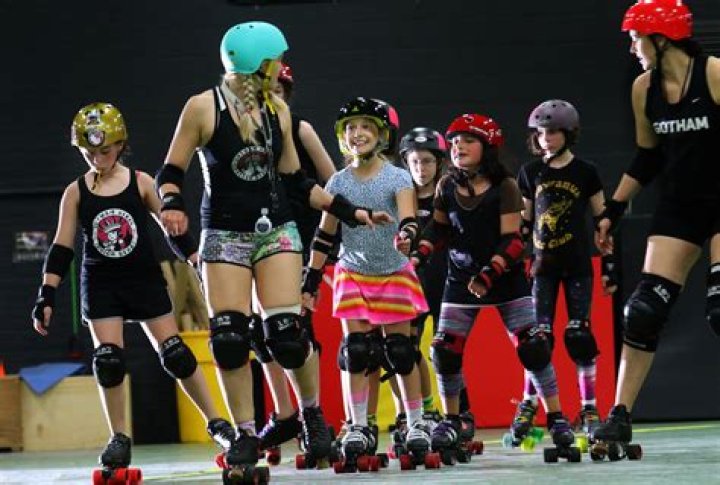
Caroline Donaghy, a co-founder of the all-female roller derby league the Charm City Roller Girls, has passed away.
According to a page on the Women’s Flat Track Derby Association website, the Charm City Roller Girls were “Maryland’s premiere all-woman flat-track roller derby league,” and they once boasted more than 80 skaters. The league competed against others across the country, and was part of the sport’s rebirth around the early 2000s.
Roller derby grew in popularity in the ’40s but declined by the early ’50s, only to spike again in the mid-’60s and early ‘70s. The sport once again died out by 1975.
As the league grew, so did its fanbase. The Charm City Roller Girls would have bouts at Du Burns Arena in Canton bringing sellout crowds of 2,000 people. Even after many years, the league’s popularity remained stable.
Many people in the Baltimore area, where the roller girls trained for many years, have indicated that Donaghy was the impetus behind their friendships.
Melanie Trigeda, a longtime friend and ex-roller girl, said, “She formed this league that connected a whole army of people that have become a family.”
“There are hundreds of individuals who are currently offering thanks and who will continue to give thanks for what she created, since she started our roller derby league, and that altered so many people’s lives,” she added.
Donaghy died on Nov. 16 at 44, acquaintances reported. There was no immediate word on what caused the death. The Baltimore Banner was unable to get in touch with Donaghy’s relatives despite repeated attempts.
Donaghy, who friends say spent much of her life in Baltimore, was inspired to form the Charm City Roller Girls after briefly moving to Texas, said Jennifer Tydings, who was Donaghy’s close friend for about 20 years and a co-founder of the league.
Donaghy joined a roller derby team in Houston while she was there and became addicted, as detailed in an article in The Baltimore Sun. To pursue her dream of establishing a league in her hometown of Baltimore, she returned there by plane.
Donaghy started a MySpace page in 2005 to find new skaters, and he also produced over a thousand flyers to publicize the fledgling league. According to Tydings, the founders have held car washes, recruitment events, and discussions with Skateland Putty Hill about renting out space for practices.
Trigeda recalled that there were ten persons or fewer at the first practice. Nonetheless, “more and more girls showing up to practice,” as she put it, meant that “it just kept growing and increasing.”
As time went on, the club grew to include roughly 80 skaters and many more spectators. Trigeda added that for many years, they put in three or four hours of practice per week.
They organized “travel teams” to compete in “bouts” (games) all across the country. For a team to get points in a bout, its designated “jammer” must successfully “block” (pass) the opposing team’s defensive skaters.
Many players also attended the league’s after-practice fundraisers and social gatherings.
Changing the name of the league to the Charm City Roller Derby in 2019 reflects “our dedication to fostering an inclusive community for all skaters, officials, and volunteer[s],” as stated on the league’s official Facebook page.
WFTDA tournaments have resumed after being postponed during the epidemic, but the Charm City Roller Derby has not been mentioned as a playing team in recent months. The staff at Charm City Roller Derby has been unresponsive to calls and messages.
According to ex-roller girl Laura Schneider, Donaghy never stopped trying to recruit new members and spectators for the Charm City Roller Girls even after the league had already formed.
She was dedicated, after all. Schneider recalls Donaghy responding to compliments about the league by asking, “Does it sound cool or are you coming to practice?”
Tydings felt confident that “it was her baby” because of this. What happened to the league and its members was very important to her.
According to those who used to be a part of the roller girls, the group evolved into a close-knit family that spread around the city and supported one another.
Schneider remarked, “If it weren’t for her, we never would have met.” “This activity she started has resulted in friendships that have lasted for years and years.”
Whether you were a volunteer “who nobody knew” or a skater, Donaghy had a way of making you feel like you mattered, according to Schneider.
When asked about her, one person commented, “She really just made everybody feel like the coolest guy in the room.”
Tydings added that after a few years of playing in the league, Donaghy left for New York and California before returning to Baltimore around six years ago.
Donaghy lived in another state, but whenever she came to Baltimore, she never missed a baseball game.
Schneider recalled that she was a regular in the front row, track side.
Friends attest that Donaghy was perpetually caring and encouraging.
During their twenties and thirties, Tydings and Donaghy shared a home. Tydings claimed that if she was having a rough week, Donaghy would prepare her packaged lunches and include notes like “Have a good day.” She whispered “I love you” inside her head.
Tydings would contact Donaghy whenever she was not feeling well. When she was feeling down, she knew she could count on her to make her laugh.
Fionnuala Brigman recalls that her friend Donaghy let her stay at her house after she split up with a lover.
Brigman claimed, “I never left her side.” She accommodated me when she didn’t have to, and I’m very grateful.
People who knew her well described her as enthusiastic and a lot of fun. Even more, she enjoyed playing Cranium and other board games.
Tydings revealed that she and Donaghy shared a joke by getting matching tattoos of spaghetti and meatballs. They often teamed up to prepare extravagant meals. Donaghy’s favorite ramen required several days of simmering a pig broth.
As Tydings put it, they even celebrated “stupid holidays” like “tap dance to work day”
Tydings claimed that the group dressed up and tap danced around town (and even the grocery store) all day long.
She was “simply a happy, delightful eccentric,” as Tydings put it.
Thanks for reading from Ghsplash a news publishing website from Ghana. Share this article, For spelling mistakes and other related issues contact us
