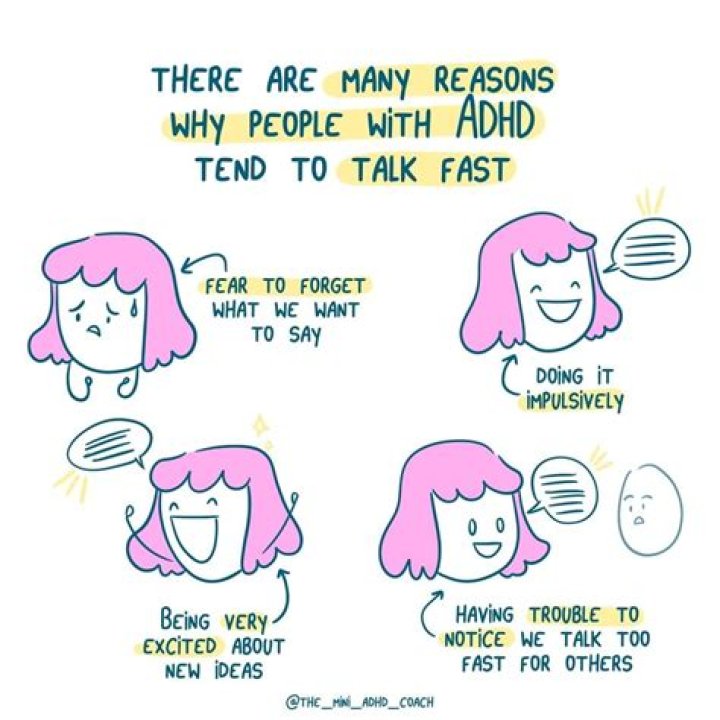
. They also do it because they feel unprepared or overawed by whom they’re speaking to, and quickly blurt out whatever they are thinking (which is often exactly what they shouldn’t be saying).
Talking too fast can be caused by the speaker having a flight of ideas that sprint through their mind too quickly to be properly articulated and is often a result of a psychological condition. One of the prime psychological causes of fast speech is bipolar disorder
speaker may be talking fast because this is a learned behavior – your. fast talking may be simple habit. Some studies have also shown that. people with Parkinson’s disease tend to speak a lot more quickly and in. a more disorder fashion than people without this disorder.
Bakker even conducted a study in 2011 called A preliminary comparison of speech rate, self-evaluation, and disfluency of people who speak exceptionally fast, clutter, or speak normally. It suggested fast talking is non-physiological, which suggests it is more likely to be psychological.
It suggested fast talking is non-physiological, which suggests it is more likely to be psychological. The study did manage to disprove the idea that fast talkers are more intelligent than slower communicaters, but I could have told them that. Listen: Most of us don’t mind a chat except if it’s on the phone.
What is the disorder that includes fast talking?
But there is a speech disorder, called cluttering, that includes fast-talking. In addition to speaking quickly, clutterers crowd their sentences with fillers (e.g., um, like), insert pauses where they don’t belong and use abnormal intonation. Both ERS and cluttering can be hard to follow, but not for the same reason.
In the early 2000s, the Discovery Channel’s Superhuman Showdown explored the medical basis of fast-talking in a segment about Fran Capo, the fastest-talking female according to the Guinness Book of World Records.
In a study, published in 2011, Bakker and colleagues compared the rate and clarity of speech in three groups of people: fast-talkers, clutterers and control group members who spoke normally.
Who wrote the post “The Languages are spoken at about the same rate”?
Post written by François Grosjean. Languages are spoken at about the same rate even though there is a lot of variability due to the speakers themselves, the situation, the topic being talked about, and so on.
The first thing we found was that, overall, second language speakers did indeed give higher estimates than native speakers. But, more interestingly, the difference between the two groups was not the same at all rates. At a slow rate, the groups gave practically the same estimates.
ADVERTISEMENT
